
Police Used Debunked Hypnosis on the Only Eyewitness. Texas Wants to Kill Charles Flores Anyways.
Experts say “investigative hypnosis” creates an unacceptably high risk of false testimony, but Texas courts have refused to hear Flores’s case. Now his life is in the Supreme Court’s hands.

This article was originally published in The Appeal. An excerpt of the story is below.
Psychological experts have roundly condemned hypnosis as junk science. But that isn’t stopping Texas from trying to execute Charles Flores, who was sent to death row based on the testimony of one eyewitness who identified him after she was hypnotized.
At least 28 states, including Texas, have banned testimony influenced by hypnosis from being introduced in criminal trials. But Flores, who was convicted in 1999, hasn’t benefited from Texas’ state law, which took effect in 2023 and is not retroactive.
In February, Flores appealed his case to the U.S. Supreme Court. The Court is expected to decide in June if it will hear his case, according to his legal team.
“Sooner or later, the truth’s gonna come out,” Flores recently told Pablo Torre on his podcast, Pablo Torre Finds Out. “And I’m going to have that opportunity to see life after this.”
More than 25 years ago, Flores was convicted for the murder of Elizabeth Black. Flores has always maintained his innocence.
The prosecution’s case hinged on the eyewitness testimony of Black’s neighbor, Jill Barganier.
At about 6:45 in the morning on Jan. 29, 1998, Barganier saw two men park in Black’s driveway and exit a Volkswagen Beetle. She said it looked like they were heading to the front door. A couple hours later, Elizabeth’s husband returned home and found his wife and their dog had been fatally shot.
Barganier’s description of the men—two white males with long hair—bears no resemblance to Flores, a Hispanic man who, at the time, was heavyset and had short, shaved hair.
Prosecutors theorized that the perpetrators broke into the Black’s house to steal a large amount of cash hidden by their son, Gary, who was incarcerated at the time on drug-related offenses. On the day of the murder, police found close to $40,000 in the Black’s home.
The police almost immediately suspected that Richard Childs, who was known to use and sell drugs, was involved in the crime. However, they first spoke with Childs’s brother, Roy, who told them Richard had recently started selling drugs for a man named Charles Flores. Richard and Roy’s father had been a police officer in the Irving Police Department, one of the agencies involved in the case.
Barganier identified Childs, who is white and had long hair at the time, as the driver from two photo arrays.
During a police interview with Childs, part of which was recorded, the police can be heard telling Childs to implicate Flores while “they all joked around together and the officers described Flores in racist terms,” according to Flores’s petition.
Flores says he panicked when he learned the police were looking for Childs’s car, which Childs had abandoned outside Flores’s trailer.
“I’m having the realization that car is behind my house,” he recently told NBC News. “I’m getting set up.”
He burned the car and fled to Mexico. When he returned, he led police on a high-speed chase and crashed his car.
“It was just pure, raw fear,” Flores told NBC News of his decision to flee. “I had that thought, ‘They’re gonna kill me, they’re gonna kill me.’ And you know what? I was right.”
On Feb. 4, the police conducted a hypnosis session with Barganier, which was recorded and has been posted on YouTube.
“When we get you into a deep state of hypnosis, we’re going to take you into a movie theater,” the officer told Barganier. “It’s going to be your own private theater. You’re going to be seeing a documentary, and you’re going to be seeing a film of the events that occurred on that day, on that morning.”
The officer asked Barganier questions that appeared designed to alter her recollection of the perpetrators’ appearance. He asked if the driver’s hair was “short,” “shaved,” or “neatly cut.” He asked whether the passenger’s hair was “neatly cut or [was] it trimmed?”
She continued to maintain that both men had long hair.
Towards the end of the session, the officer seemed to prime her to create new memories, telling her she “will be able to recall more things as time goes on.”
Immediately after the session, she used a computer to create a composite sketch of the passenger; the picture depicts a white man with long hair.
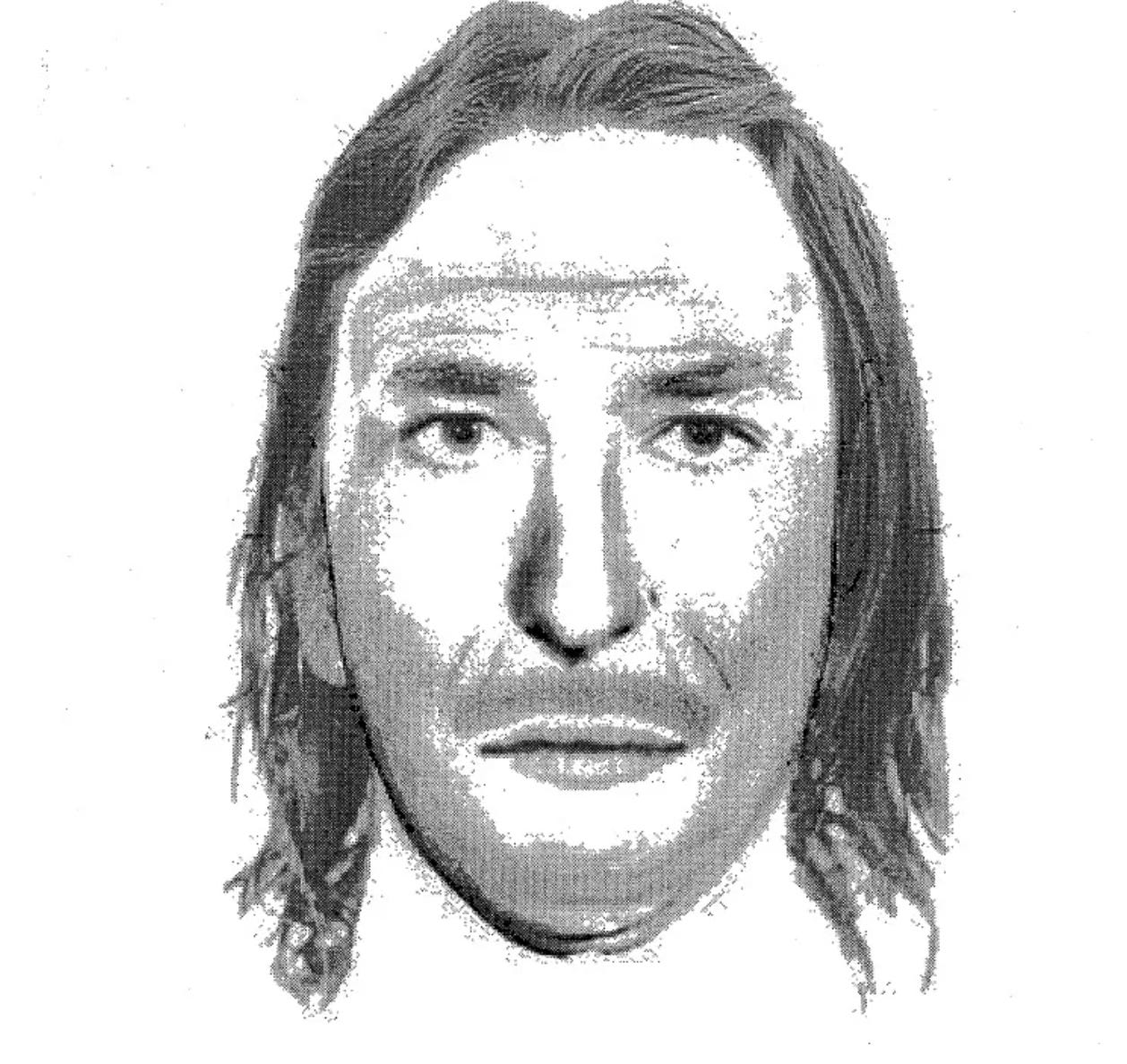
The composite sketch police generated based on Barganier’s description of the passenger.
She was then shown a photo array of Hispanic men with short hair, including Flores, whose hair was almost buzzed down to his scalp. She did not pick anyone out.
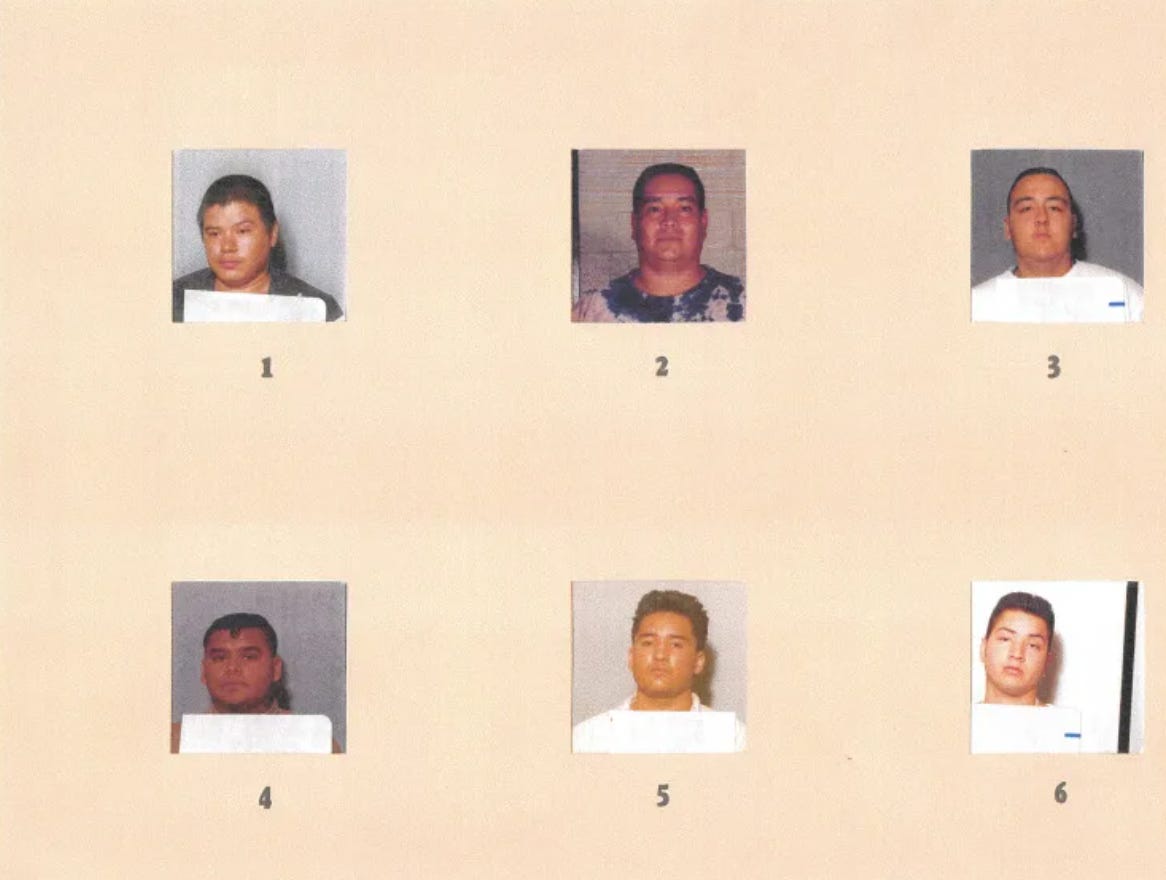
The photo array shown to Barganier. Flores is photo number 2.
About a year later, Flores was on trial for murder, accused of fatally shooting Black. Without an eyewitness identification or any physical evidence, the State’s case was weak.
But all that changed when Barganier arrived in court. She saw Flores, the only Hispanic person in the courtroom, sitting at the defense table. Local news outlets had published his picture numerous times over the previous year, the same picture she had viewed in the photo array. For the first time, she told prosecutors that he was the passenger in the car.
On the witness stand, Barganier said she was “[o]ver 100 percent” certain.
Barganier’s confidence is not surprising. Research has shown that hypnosis can lead witnesses to become more confident in their memory, even if it is false. Confidence can be persuasive to members of a jury, who can wrongly assume confidence correlates with accuracy.
The jury found Flores guilty and sentenced him to death.
Childs did not testify at Flores’s trial. After he was convicted, Childs submitted a confession to the court stating that he shot Black, contradicting the prosecutor’s assertion at Flores’s trial that Flores was the shooter.
Childs pleaded guilty and was sentenced to 35 years. In 2016, Childs was paroled after serving only a portion of his sentence. That same year, the Texas Court of Criminal Appeals granted Flores a stay, just days before he was scheduled to be executed.
Read the full story at The Appeal.